Balcony or Stalls: What the Layout Changes
Balcony or stalls seating changes distance, sightline and the feel of a theatre. Learn what to check before choosing a seat for a particular show.
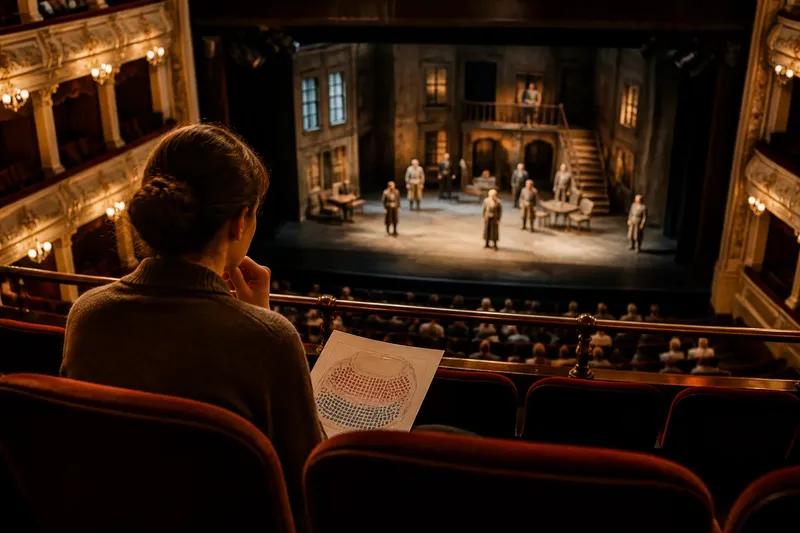
Balcony or stalls seating can change whether you catch a performer’s expression, see the full stage picture or feel close to the room’s shared energy. Say you are choosing between two available seats for the same play: one in the stalls and one on the balcony. The useful question is not which is better in general, but what each position lets you see and how you want to experience the performance.
Balcony or stalls seating begins with the shape of the room
“Stalls” usually means the main seating area at stage level, while a balcony is an elevated section overlooking it. Names and arrangements vary by theatre: some rooms have several balconies, a gallery, a dress circle or a mezzanine, and the boundary between labels is not always obvious. The seating plan matters more than the word printed beside a ticket.
From the stalls, the stage often appears at a more direct angle. You may feel physically close to the performers, particularly in a compact room, but seats towards the back can still be far from the action. A central seat and one near the side can also offer noticeably different views, even in the same row.
From a balcony, height can make the overall arrangement of the stage easier to read. You may see entrances, group movement and the relationship between performers and scenery at once. The trade-off is that faces and small gestures can feel more distant, and the view may be angled rather than level.
Distance changes what holds your attention
Imagine the invented situation: Mara is choosing a seat for a new play in a theatre she has not visited. The seating plan shows a stalls seat near the front on one side and a central balcony seat above the main seating area. She knows the production uses a large cast and has no further information about its staging.
Mara first considers what she hopes to notice. If the play relies on subtle facial reactions, proximity may be appealing, although a front-side position could make some parts of the stage harder to see. If the production uses formations or movement across the full width, the central elevated seat may make those patterns easier to follow.
Neither choice settles the question by itself. A balcony seat can be close enough to feel engaged in a small theatre, while a rear stalls seat can provide a broad view from farther away. The room’s scale and the seat’s location within its section matter alongside the section name.
For a simple analogy, choosing between these views is a little like looking at a crowded table: standing close helps you notice one person’s expression, while stepping back makes the whole arrangement clearer. Theatre is less tidy than a table, naturally, but the shift in attention is similar.
Height can clarify the stage and expose its limits
An elevated seat may show how scenes are composed across the stage. In a production with several performers moving at once, height can help you follow the full picture rather than settling on whichever person is nearest. It may also reveal the shape of a set more clearly, including where levels or playing areas meet.
That wider view can come with a steeper angle. Depending on the room, the balcony rail, the person in front or the stage’s own depth may affect what is visible. A seat directly above the stalls is not automatically the clearest one; a far-side position may look across the stage at an awkward angle.
The stalls offer a different kind of access. A level, forward view can make performers feel present and make quiet details easier to attend to. But a low angle can make the rear of a deep stage harder to read, and a nearby seat at the side may leave you turning your attention repeatedly towards the centre.
For Mara, the decision now turns on the theatre’s plan, not an imagined rule that the front is always best. She checks whether the stalls seat sits well off-centre and whether the balcony seat is described or marked as restricted. She also looks for an interior view, if the venue provides one, to understand the direction each section faces.
Room atmosphere is part of the seat
The stalls can make the audience feel close to the performance and to one another. You may hear reactions nearby and feel the room’s attention gather around the stage. That closeness can be absorbing, though it can also make individual distractions more noticeable.
A balcony can feel more separate from the crowd below. From above, the audience itself becomes part of the view, and the room’s scale may be more apparent. Some people enjoy this broader perspective; others prefer to feel nearer the performers. These are preferences, not defects in either section.
The architecture also affects how sound reaches a seat. A venue may be designed to carry voices across its different levels, but the experience can still vary with position and the production’s sound design. If hearing is a concern, consult the venue’s access information or contact its staff about the available arrangements rather than assuming one level will suit everyone.
What should you check before choosing a section?
Does the production use the whole stage?
A busy stage picture may be easier to take in from a central elevated position, while a performance built around small expressions may draw you towards a closer view. The production description can offer clues, but it cannot promise exactly how a scene will look from a particular seat.
Is the seat central or at the side?
Compare the seat’s position with the stage on the seating plan rather than judging by section alone. A side seat may give you a more oblique view, while a central position can make the stage picture feel more balanced.
Could a rail or another obstruction affect the view?
Look for restricted-view notes, seat symbols and photographs of the auditorium. If the plan does not explain a marking, ask the box office what it means before booking.
Which kind of distance suits your attention?
Choose the stalls if a closer sense of presence matters more to you, and consider the balcony if seeing the wider stage arrangement matters more. Treat this as a preference to weigh against the actual seat position, not as a promise about the performance.
Mara chooses for the play she expects to watch
After checking the plan, Mara notices that her stalls seat is close but well to one side, while the balcony seat is central and has no restricted-view mark. She chooses the balcony because she expects to follow the movement of the larger cast and prefers a clear view of the whole stage. The expected result is a more legible overall composition, with less access to small facial detail than she might have had from a closer seat.
That choice would change if her priorities changed. If she were more interested in performers’ expressions than in the arrangement of the group, or if the balcony position looked sharply angled, the stalls might make more sense. The point is not to predict every moment, but to match a seat’s likely strengths to the kind of attention she wants to bring.
Choose the view, not the label
For balcony or stalls seating, compare the actual position, angle and distance before deciding what the section name implies. Check the venue’s seating plan, note any view restrictions and consider whether you value intimacy or a broad stage picture more. If a label, accessibility arrangement or seat restriction is unclear, follow the venue’s information or ask its staff; room layouts and policies differ.
A seat cannot determine whether you enjoy a show, but it can shape what you notice first. Mara’s central balcony seat gives her a view of the group as a whole; another theatregoer might reasonably prefer the nearer, more oblique stalls view. Choosing with that distinction in mind is more useful than searching for a universal best seat.