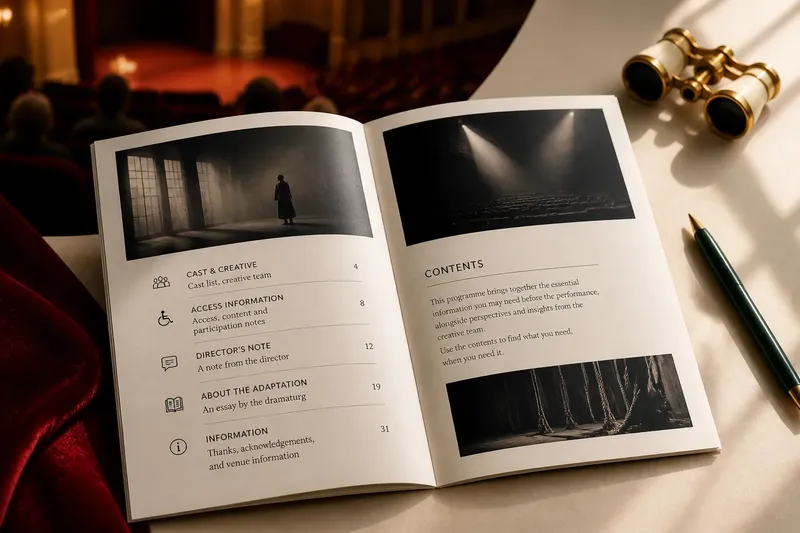
How to Use a Theatre Programme Before the Curtain Rises
A theatre programme can help you find cast details, access information and production context before the show, without forcing you to read every page.
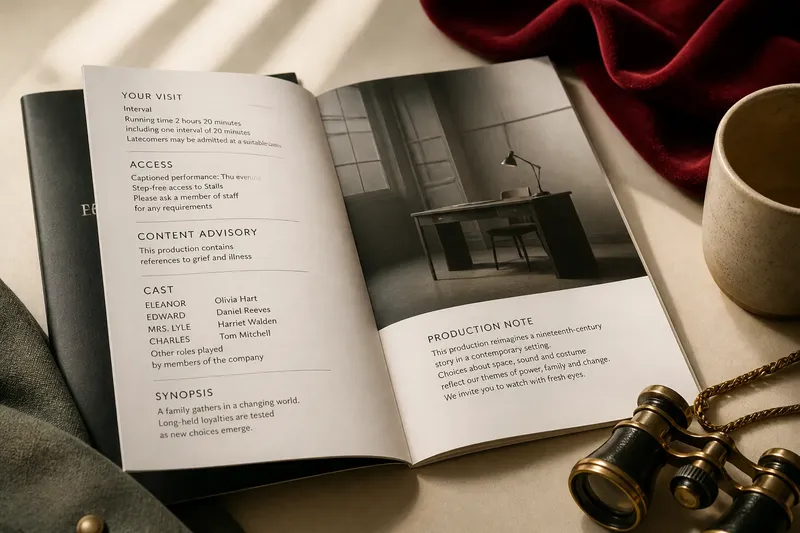
Trying to find out whether a performance has an interval should not require deciphering the director’s note. A theatre programme is most useful when you know which page can answer the question in front of you, and which pages can wait.
Use it as a reference rather than a book you must read from cover to cover. The cast, access notices, running information and production notes serve different needs, so a quick scan can help you keep your attention on the stage.
Start with the information that affects your evening
Before taking your seat, look for practical notices near the front, a contents page, or a section headed “Your visit”. Check the programme for interval information, content advisories, surtitles, and any access arrangements relevant to your visit.
Printed programmes vary, and some details may be provided separately by the venue. If the programme does not answer a practical question, check the venue’s website or ask a member of staff rather than guessing.
- Observe whether the programme states that there is an interval; if it does, use that information to plan a break, and if it does not, ask venue staff rather than assuming.
- Observe whether an access notice mentions surtitles or another feature you need; if it does, note where and when it applies, and if it does not, ask the venue for clarification.
- Observe whether a content advisory is present and relevant to you; if it is, read its wording before the performance, and if it is absent or unclear, check the venue’s information or speak to staff.
- Observe whether the programme identifies a running order or scene sequence; if it does, use it to orient yourself, and if it does not, avoid inferring the structure from page length.
- Observe whether a practical detail is available only through a digital link; if your phone can be checked comfortably before the show, open the page then, and if not, ask staff for the information.
- Observe whether a notice conflicts with information you received from the venue; if it does, ask staff which applies to your performance, and if the venue cannot clarify it, follow the venue’s current instructions.
Use cast information as a reference, not a memory test
A cast list may be organised by character, performer or scene. Read its headings before matching names, and look for notes about role doubling, understudies or changes in the cast. One performer may play more than one character, so the list does not always work as a simple one-to-one chart.
If you lose track of a name, consult the cast page during a suitable pause rather than trying to memorise it all beforehand. Like a drawer label, the page helps when you need to locate something; it need not become an evening’s homework.
Choose how much story context you want
A synopsis can clarify relationships, setting or unfamiliar references. It can also give away events that the performance is designed to reveal gradually. Check headings and the opening lines before reading on; if the amount of plot detail is unclear, leave the synopsis for after the show.
Production notes answer a different question. A director’s or designer’s note may explain choices about staging, costumes or sound, but it is one perspective on the production rather than a set of instructions for the audience.
Separate the source story from the staging
A programme may describe a source play while the production changes its setting, sequence, names or emphasis. Treat the synopsis as information about the underlying story, then use the performance itself to see what the staging does with it.
Imagine you are attending a contemporary staging of a nineteenth-century play. The programme describes a drawing room, but the set is a bare office. You read the synopsis for the relationships and leave the production note until after the performance; that gives you the source story without dictating what the office should mean.
Which programme pages should you read first?
Should you read the synopsis before the show?
Read it beforehand if knowing the setting or relationships will help you follow the action. If you prefer to discover the plot in the theatre, skip it and use the cast list for orientation.
What should you do if the programme omits the running order?
Check the venue’s current information or ask an usher. Do not infer the interval or finish time from the number of pages.
Is a digital programme better than a printed one?
A digital version may be easier to search or enlarge, while a printed copy can be consulted without a glowing screen. Choose the format that lets you find the information you need discreetly.
Should you keep the programme afterwards?
Keep it if you want a record of the cast, creative team or notes for later. If it served only to answer a practical question, you do not need to turn it into an archive.
Make the programme answer one question at a time
Say you have a programme for a performance whose synopsis may contain spoilers, and you want to know whether there is an interval before making plans. First, check the contents page and the notices near the front; suppose the programme gives an interval notice but leaves the synopsis unlabelled. Use the interval information, skip the synopsis, and ask venue staff if the notice does not say when the break occurs. The result is a practical answer without reading plot details you would rather save for the performance.
For theatre programme information, begin with the question that matters now: who is on stage, what access information applies, or whether the evening includes a break. If the programme cannot answer it clearly, the venue is the better source than a guess made in the dark.